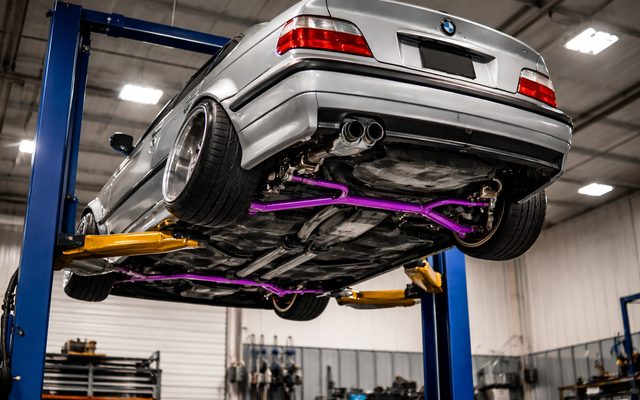
Inside the high-stakes realm of today's serious oversteer competition, success is no longer exclusively a product of brute engine power or pilot courage. Rather, it is now a multifaceted engineering challenge which necessitates a scrupulous blend of picking a time-tested car, arming it with the correct competition hardware, and, most critically, understanding its dynamic characteristics on the course through cutting-edge suspension tuning applications. This definitive manual functions as your blueprint from the initial concept of a drift build through to the last engineering-refined tweaks that elevate a powerful machine into a repeatable champion. We will delve deep into the precise engineering of chassis dynamics adjustment, showing how a advanced suspension tuning tool like GripDial removes assumptions and delivers unmatched visibility into your car's actual behavior.
The cornerstone of any exceptional drift machine is, undoubtedly, the platform itself. A select group of cars have earned iconic status within the global drifting community due to their inherent handling characteristics, robust build quality, and the immense availability of aftermarket support available. Choosing the correct starting point is the primary and most crucial decision a enthusiast will make. To illustrate, the the E36 generation BMW is widely regarded as one of the finest overall drift platforms of the modern era. Its excellent 50/50 weight distribution, coupled with a rear-wheel-drive setup and bulletproof inline-six powerplants, forms a platform that is simultaneously forgiving for newcomers and extremely capable in the control of a professional pilot. The successor of this concept, the BMW E46, refines these qualities with a increasingly developed chassis, broader wheel track for enhanced high-speed stability, and yet more turning capability straight from the manufacturer. A distinct powerful option in the pro circuit is the Corvette C6.
This muscle-derived track weapon offers a particular combination of strengths to the sideways sport, such as a light aluminium frame, a transaxle-style gearbox and differential unit that aids in an perfect balance, and the tremendous torque of a big GM LS engine. This blend makes it an utter weapon on track, able of entering and holding long slides with seemingly easy use of power. For drivers desiring exceptional performance per dollar, the Nissan 350Z excels as a prime example. It comes from the manufacturer with a robust chassis, a effective original limited-slip differential, and the smooth VQ series motor that delivers sufficient power and torque for mastering and progressing in the discipline. Its successor, the 370Z model, brings more refinements in structural rigidity, steering geometry, and outright motor performance, cementing its position as a common selection among serious pilots. Other iconic vehicles that deserve consideration are the lightweight Wankel-engined Mazda FC, the most popular Nissan S13 240SX, the torque-rich Ford Mustang SN95, the modern E90 3 Series, and the small yet incredibly engaging and forgiving Mazda Miata. All of these platforms provides a different array of traits, difficulties, and possibilities, but they all possess the fundamental ingredients necessary to be transformed into a capable drift machine.
However, choosing the correct car is only the beginning. To access the complete performance of any of these machines, significant changes to the steering system and damping and springing systems are completely mandatory. This is where the world of precision drift-spec hardware comes into critical focus. The single most game-changing upgrade for a purpose-built competition vehicle is the fitting of a high-performance angle modification kit. These sophisticated kits, such as those engineered by performance brands like SLR Speed, are created to dramatically increase the chassis's possible steering angle. A standard road car is extremely limited in how far its front wheels can pivot, a engineering compromise for daily operation. In sliding, however, extreme steering input is continuously required to manage and hold a slide. An modification kit exchanges the factory hubs, rod ends, and sometimes A-arms with parts that allow the steered wheels to reach angles beyond 70 or even 80 degrees, as opposed to a average factory angle of around 40 to 50 degrees.
This tremendously expanded capability gives the driver with exponentially enhanced control during a angle, making it considerably simpler to begin a slide, hold it through a long bend, and transition fluidly from one direction to the opposite. The difference in controllability is nothing short of transformative. Paired with a correctly specified steering kit is the every bit as critical modification to the vehicle's damping system. Generic or including high-end street dampers are just not designed for the particular and harsh demands of competitive oversteer. A dedicated system of adjustable dampers is paramount. These engineered coilovers have specific piston tuning and spring stiffness that are optimized for the rapid weight transfer that is typical of drifting. When a operator initiates a angle, the vehicle's inertia is thrown violently to the outside of the corner. Optimal performance suspension control this transfer in a controllable way, allowing the vehicle to stabilize rapidly and giving the operator precise feedback through the controls and driver's seat. They also enable precise setting of ground clearance, damping rate, and cross-weight, which are all integral elements of dialing in the chassis's behavior to a specific track or driving style. Together, a high-quality drift angle kit and a expertly selected system of drift-spec coilovers are the undeniable physical foundation upon which all future refinement is constructed.
Once the core parts is fitted, the subsequent critical step in the project is the meticulous adjustment of the chassis's suspension geometry. This is the realm of vehicle alignment optimization, a procedure that can appear daunting to the beginner but is, in practice, the defining factor to turning a set of capable components into a unified and consistent vehicle. The most discussed aspect of alignment for oversteer is definitely negative camber. Camber angle is the tilt of the wheel relative to the perfectly straight line when observed from the front-on of the vehicle. When the top edge of the tire is angled towards the chassis, this is known as camber-in. In oversteer driving, an inward tilt on the front wheels is universally employed and is considered necessary. The logic is intrinsically tied to vehicle dynamics.
When a car is turning at high slip angles, the chassis leans towards the outer of the corner. This chassis roll makes the outside steering tire to lose its optimal footprint with the tarmac. By applying an inward tilt, the tire is pre-tilted to account for this lean. As the car tilts into the turn, the outside front tire gains a better contact patch on the road surface, optimizing its grip at the critical time when it is needed most for directional command. Typically, front axle camber settings for a competition drift machine range from approximately -3 degrees to as extreme as -5 degrees or even more, contingent on the details of the vehicle configuration, compound selection, and driver preference. The back wheels also use inward tilt, but the settings are typically less and subtler than the front axle. Overly aggressive camber at the rear can result in the chassis extremely loose and difficult to manage on acceleration use, as it reduces the available tire footprint of the driving tires during linear throttle application. Hence, rear axle angles are often in the vicinity of -1 degree to -3 degrees, finding a careful equilibrium between providing enough lateral traction to assist in starting and holding the drift while simultaneously maintaining good hook-up for exiting the turn. camber angle is just one component of the larger suspension geometry equation, which furthermore encompasses toe angle, self-centering steering, and steer correction correction.
Toe setting refers to the angle of the tires when viewed from above. Inward toe means the leading edges of the wheels are closer together than the trailing edges, while toe-out means the opposite. For sliding, a modest amount of front toe out is commonly used to quicken the initial directional feel, making the chassis feel more nimble and ready to begin a oversteer moment. Rear axle toe angle is generally set to neutral or a incredibly slight amount of toe-in to promote predictability under power. self-centering is the longitudinal or aft inclination of the steering axis when viewed from the side-on of the car. More caster angle increases steering feel and high-speed confidence, and it furthermore adds to negative camber gain during cornering, which is extremely useful. Tuning these settings is a intricate interplay where a change to one setting can and often will influence the remaining parameters. The old-school approach for dialing in a chassis's suspension geometry for sliding has for a long time been a tedious endeavor of trial and error. A tuner or crew would make a change based on a hunch, test the car on track, depend on the operator's personal feel and impressions, and then apply another tweak. This process would continue over and over until the chassis felt "right" or the available practice session ran out. This system is not only incredibly wasteful in terms of hours and resources, but it is furthermore inherently imprecise.
Pilot feel is a famously inconsistent data source, colored by countless elements such as tiredness, evolving track surfaces, temperature, and just the mood of the pilot on that particular run. What feels "loose" on one pass might feel "tight" on the subsequent lap, causing confusing data and counterproductive changes. This age-old limitation in chassis setup is exactly where modern telemetry systems has made its mark to completely change the process.
The development and adoption of advanced suspension tuning applications has brought about a new paradigm for building and perfecting high-performance drift cars. This new generation of systems, showcased by innovative systems like modern telemetry hardware, function by physically measuring the live physical movement of the vehicle as it is operated on the course. In contrast to using drift tuning app personal feedback, these tools acquire quantifiable data on essential variables such as shock absorber movement, wheel speed, lateral and longitudinal g-forces, lock position, and accelerator and brake pedal application. This acquired information flow is then interpreted by advanced software that can graph and interpret the metrics in a clear format. For the first time, drivers and crews can visualize precisely what the chassis is performing at each millisecond of a lap. This capability revolutionizes the entire chassis setup process. Think about the specific task of setting the front negative camber for a particular car. As an alternative to applying a change from -3 degrees to -3.5 degrees and then running many laps to try and "perceive" a change, a suspension tuning tool can give immediate and definitive data. The tool can display graphically how the wheel's contact patch is performing during the critical moments of a drift: the initial flick, mid-corner, and changing direction. It can demonstrate if the present camber setting is permitting the outside front tire to achieve optimal grip or if the tire is over-stressed on its outer edge.
The software can then make fact-based suggestions for modification. Perhaps the data shows that the tire is even stressing its outer shoulder at -3.5 degrees of negative camber, indicating that even more negative camber, say -4 degrees, might be warranted. Alternatively, the information might indicate that the tread is failing to reaching temperature or that the inside shoulder is degrading excessively, which could point to that there is too much angle and a slight lessening back to -3.2 degrees would be more efficient. This level of accuracy and actionable intelligence was completely unattainable in the days of pure seat-of-the-pants setup.
The impact of coilover setup tips employing a advanced drift telemetry system goes far beyond just optimizing alignment. It serves as an essential damper adjustment manual that is tailored to your particular vehicle. When setting the rebound and compression settings on your suspension, instead of using vague guidelines or copying another car's setup, you can utilize the telemetry to observe how the chassis is reacting in reaction to your changes. The application can show the wheel movement data over a run, revealing if the coilovers are managing the weight transfer optimally or if they are permitting the chassis to bounce uncontrollably after a direction change. It can aid in identifying issues like excessive compression or losing droop, enabling you to introduce data-backed choices to preload settings, rebound/compression values, or ground clearance. This process extends just as well to the complex process of car alignment tuning. In addition to camber, the system can give insight into how modifications to toe and caster angle are affecting the vehicle's balance during specific maneuvers of a drift. For instance, it can help you to determine the ideal amount of front axle negative toe for your particular angle kit geometry and driving technique by analyzing the quickness of turn-in reaction and the predictability of the chassis at full lock. This transforms the software an exceptionally useful vehicle dynamics manual that is actively informed by the real-world performance of your own car vehicle dynamics tool on the track. It moves the entire endeavor from a dark art into a methodical optimization process.
Moreover, the utility of a tool like modern telemetry is not at all confined to expert teams with vast budgets. For the club-level enthusiast, it acts as an powerful educational tool. It practically provides the builder with the analysis of a full-time race engineer without requiring the corresponding cost. It drastically shortens the development time by providing unambiguous answers to challenges that would traditionally take countless track days of trial and error to understand. A builder can learn how their individual chassis behaves to different settings, building a more intuitive comprehension of suspension theory in the journey. It also makes accessible advanced suspension engineering concepts, enabling all drivers with the desire to optimize their machine to do so in a structured and productive fashion. This is notably important in a discipline like sliding, where engineering expertise has historically been a tightly held asset among elite crews. In the modern era, that knowledge can be in the hands of any serious driver.
In summary, the process to constructing and optimizing the ultimate competitive drift car is a multi-faceted project that perfectly blends time-honored hardware wisdom with revolutionary telemetry solutions. It commences with the informed pick of a legendary car, followed by the application of non-negotiable competition parts like high-performance steering angle kits and properly selected performance adjustable dampers. The process then moves into the precision phase of car suspension tuning, where parameters like negative camber, toe, and caster are precisely set to match the chassis's modified capabilities and the operator's individual style. The final step, and what genuinely separates the today's methodology from the past, is the use of a advanced drift telemetry software. This platform eliminates the approximation and waste of only feel-based tuning by giving objective, actual data on how the chassis is truly functioning. It serves as an indispensable suspension tuning tool, a actionable alignment optimization handbook, and a master performance analyzer. Together, this holistic philosophy leads to that each and every aspect of the competition vehicle—from the pick of the platform to the final tweak on the coilover—is refined for ultimate competitiveness on the circuit. It signifies the complete maturation of the sport of oversteer driving, bridging mechanical driving skill with data-informed chassis dynamics to create the perfect effective vehicles possible.